Best Over-the-Counter Hearing Aids for Seniors 2026
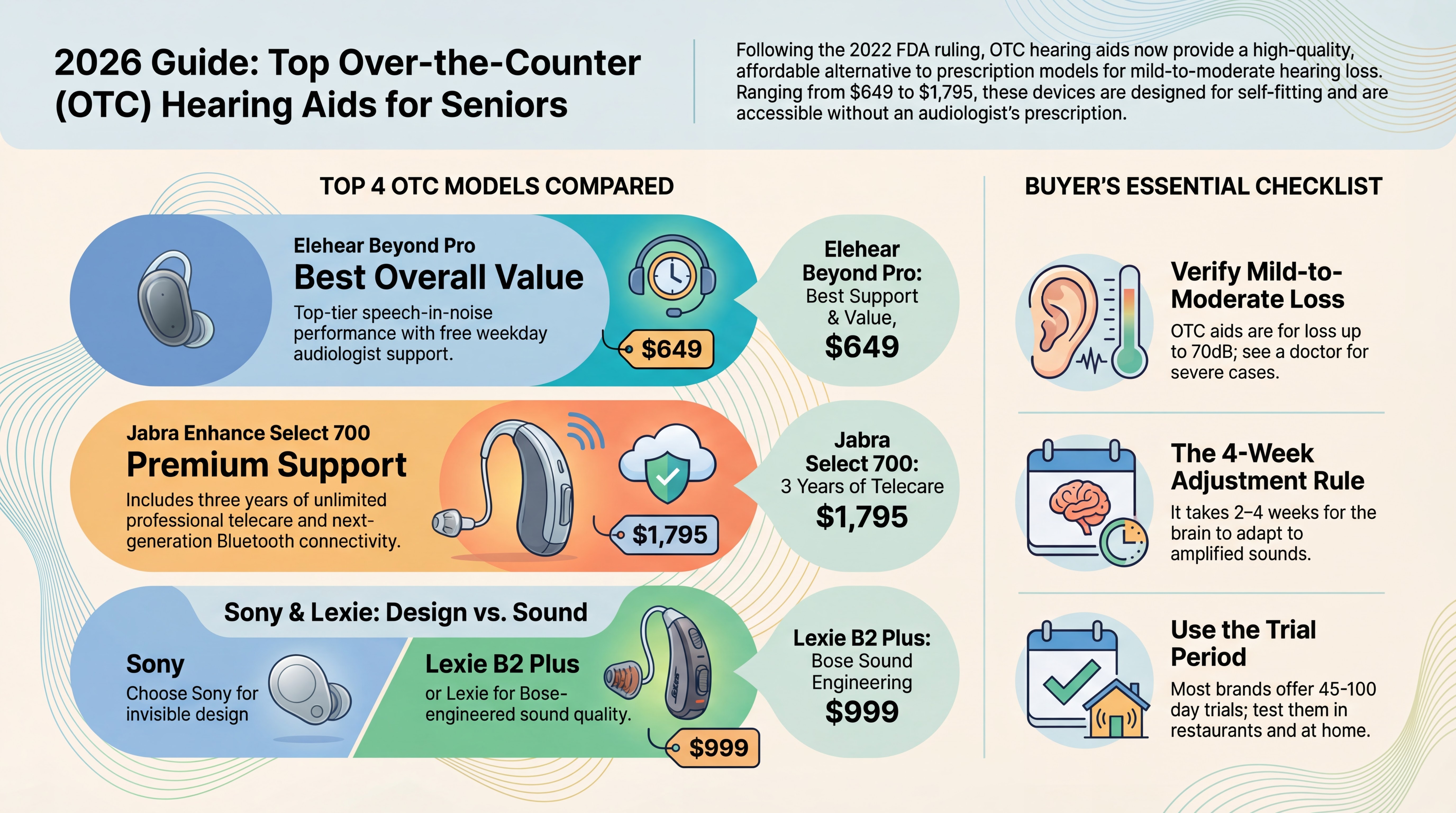
Over-the-counter hearing aids became FDA-regulated in 2022, opening access to affordable devices for the 48 million Americans with mild-to-moderate hearing loss. For Medicare seniors, OTC hearing aids offer a budget-friendly alternative to prescription devices—often at half the cost—while still delivering prescription-grade sound quality and professional remote support.
Our Top Pick
Elehear Beyond Pro
Best overall value for seniors who want audiologist-backed customization and lab-tested performance without the $3,000+ prescription price tag.
Quick Comparison
| Product | Price | Rating | |
|---|---|---|---|
Top Pick Elehear Beyond Pro Elehear | $649 | 4.4 | Check Price |
Runner-Up Jabra Enhance Select 700 Jabra | $1,795 | 4.1 | Check Price |
Runner-Up Sony CRE-E10 Sony | $1,099 | 4 | Check Price |
Lexie B2 Plus Powered by Bose Lexie | $999 | 4.2 | Check Price |
Video Review
Listen to This Guide
Visual Guide
Detailed Reviews
1. Elehear Beyond Pro
Elehear
Best overall value for seniors who want audiologist-backed customization and lab-tested performance without the $3,000+ prescription price tag.
View Elehear Beyond Pro on AmazonWhat we like
- +Top 2% HearAdvisor lab score for speech-in-noise performance
- +Self-fitting with audiogram upload and remote audiologist programming
- +VocClear 2.0 AI algorithm delivers 30% clearer speech clarity
- +Licensed audiologist support via app Monday-Friday at no extra cost
Watch out for
- −Audiologist care only available weekdays (no weekend support)
- −Larger receiver-in-canal (RIC) design may be visible behind the ear
2. Jabra Enhance Select 700
Jabra
Premium pick for seniors who value cutting-edge Bluetooth tech and want three years of professional support baked into the price.
What we like
- +3 years of licensed audiologist telecare included in purchase price
- +Bluetooth LE Audio with Auracast for next-gen streaming (iOS and Android)
- +Tiny, discreet receiver-in-canal design built on GN ReSound technology
- +SoundScape Auto Focus adaptive noise reduction for restaurants and crowds
Watch out for
- −At $1,795, priced near entry-level prescription hearing aids
- −No in-person fitting—remote care only, which may not suit all seniors
3. Sony CRE-E10
Sony
Best discreet option for iPhone users who prioritize invisible design and self-fitting simplicity over professional support.
What we like
- +Nearly invisible earbud-style design fits entirely in the ear canal
- +Self-fitting with in-app hearing test and preset customization
- +Bluetooth streaming and hands-free calling for iPhone (iOS 13.0+)
- +Rechargeable with compact charging case (up to 26 hours total battery)
Watch out for
- −iOS-only Bluetooth streaming (Android users cannot stream audio)
- −No licensed audiologist support—app-based troubleshooting only
4. Lexie B2 Plus Powered by Bose
Lexie
Excellent mid-range choice for seniors who prioritize Bose-quality sound and want flexible Bluetooth connectivity for music and calls.
What we like
- +Highest sound quality rating from NCOA testers among all OTC devices tested
- +Bose engineering with self-fitting app and preset environmental modes
- +Bluetooth streaming for iOS and Android with excellent audio clarity
- +Access to licensed hearing professionals for remote support via app
Watch out for
- −Behind-the-ear design is more visible than completely-in-canal models
- −Remote support available but not included—requires separate appointment booking
How We Evaluated
We evaluated OTC hearing aids based on audiologist testing from HearingTracker's acoustic lab (95+ models tested), Consumer Reports' professional equipment and user panel testing, and verified customer reviews from Amazon. Products were scored on speech-in-noise performance, ease of setup, comfort, battery life, Bluetooth reliability, and access to licensed audiologist support. Only FDA-cleared self-fitting or preset OTC devices for mild-to-moderate hearing loss were considered—personal sound amplification products (PSAPs) were excluded.
Frequently Asked Questions
Does Medicare cover over-the-counter hearing aids?▾
What's the difference between OTC hearing aids and personal sound amplifiers (PSAPs)?▾
Do OTC hearing aids have trial periods?▾
Can I use Bluetooth with OTC hearing aids for phone calls and TV?▾
How long do OTC hearing aid batteries last?▾
Product recommendations are based on independent video reviews and expert analysis. Prices and availability may change. As an Amazon Associate, we earn from qualifying purchases. We may also earn commissions from other affiliate programs listed above. This does not affect our recommendations.
← All Product Reviews